Leather Watch Strap Patina: Natural vs Hand-Dyed Explained
A leather watch strap patina is the change in color, sheen and feel that leather picks up as you wear it. Light, skin oils, moisture and flexing darken some areas and polish others, so the strap slowly records how you use it. A "patina strap" can also mean something different: a strap whose shaded color is applied by hand in the workshop before you ever wear it.
What is leather watch strap patina, exactly?
Patina is not a coating or a defect. It is the visible result of the leather reacting to its surroundings. On a watch strap, that reaction can be faster than on a bag or a belt, because the strap sits against warm skin, bends at the same points every day and is exposed to daylight almost every time you wear it.
The word is used in two ways, and it helps to keep them apart when you shop:
- Natural patina: the change that happens after you buy the strap. It is slow, uneven and impossible to repeat exactly.
- Hand-dyed patina: a finish created on purpose, with color worked into the leather by hand so it shifts from deep to bright across the strap.
- Both at once: a hand-dyed strap on vegetable-tanned leather keeps aging after it leaves the workshop, so the applied color deepens further with wear.
Most confusion comes from mixing these up: a strap sold as "patina" may look aged on day one yet change little, or look plain and change a lot.
Which leathers develop a natural patina?
How much a strap changes depends more on the tanning and finish than on the color. Leathers that are open and lightly finished absorb oils and light; leathers with a pressed or sealed surface hold their look.
- Vegetable-tanned leather changes the most. It starts pale, darkens with light and handling, and takes on a soft shine where it rubs.
- Waxed cowhide changes through movement. The wax and oil inside it shift when it bends, lightening the folds and settling back darker.
- Italian bull leather is thick and firm. It breaks in slowly and ends up molded to one wrist.
- Pressed-grain calfskins such as Epsom change the least. Their surface is designed to stay crisp and even, and suits anyone who wants a strap to look new for longer.
Neither group is better; it depends on whether you want a strap that tells a story.
How does a leather watch strap patina develop over time?
No two straps age at the same speed, because skin chemistry, climate and wearing habits differ. There is still a typical order of events on vegetable-tanned and waxed leathers.
- The first weeks: the strap softens and starts to follow the curve of your wrist. Color barely moves, apart from slight darkening around the holes you use.
- The first months: the side touching your skin and the area near the buckle darken first. Light scratches blend into the surface instead of standing out.
- The first year: a light tan typically deepens a shade or two. Flex points look lighter or more polished, and the lug ends turn darker.
- Years of wear: the strap carries several tones at once, with a burnished sheen on high-contact areas and a matte finish elsewhere.
Sun speeds the process up, and so do sweat and humidity. Exotic leathers change much more slowly; alligator picks up a quiet patina over years rather than months.
What is hand-dyed patina, and is it the same thing?
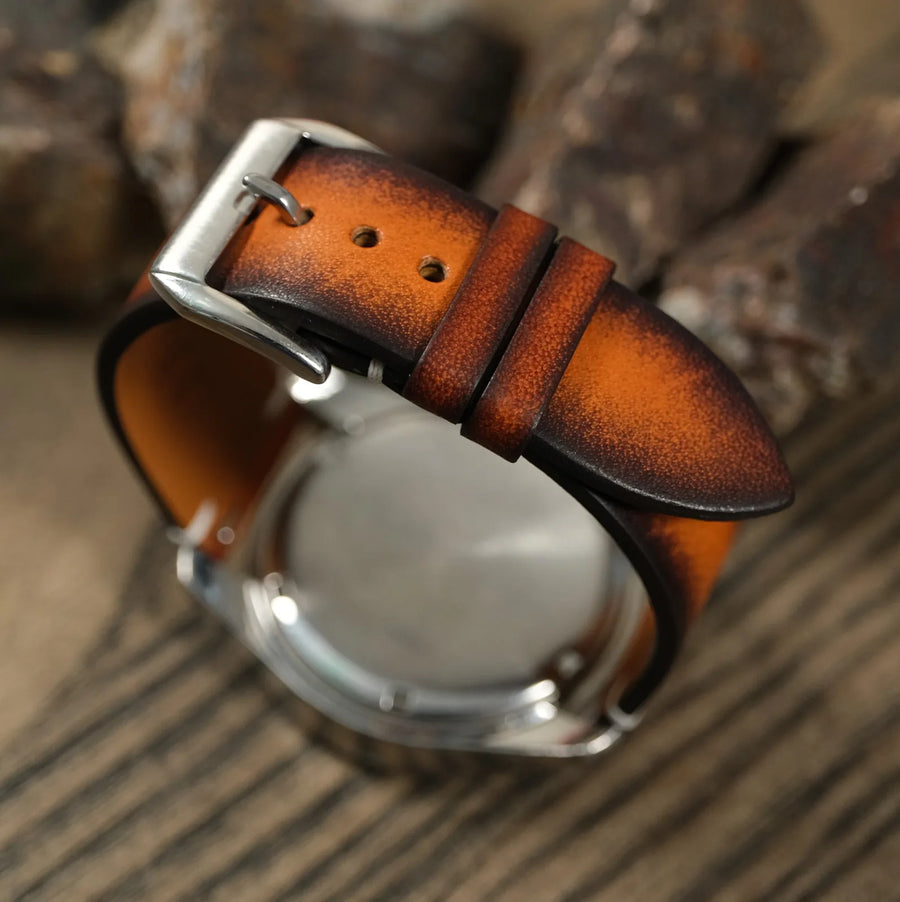
Hand-dyed patina is a finish, not a sign of age. Our XILUGS Signature Patina is hand-dyed vegetable-tanned calf: the color is built up by hand in thin layers, so the strap is bright along the raised center and deep at the edges.

Because the base is vegetable-tanned, the leather under the dye still darkens gently with time and light. In practice, you get both kinds of patina: the shading you chose at the start, deepening slowly as you wear it. The practical takeaway: ask which kind of patina you are buying, then choose the leather.
How do patina leathers compare?
Match the leather to how much change you want to see on your wrist.
- XILUGS Signature Patina (hand-dyed vegtan): hand-dyed, then natural. The applied shading deepens gently with light, so it looks finished on day one and keeps developing.
- Wood Grain Patina: a hand-dyed figure, then natural. Tan versions darken a shade or two in the first year, and the figure reads best in raking light.
- Italian bull patina: hand-dyed, then natural. It starts firm and softens over the first weeks, for the most lived-in result over time.
- Waxed cowhide: natural pull-up. Folds lighten, then settle darker, and scuffs rub out: a rugged strap that looks better used than new.
- Patina alligator: hand-dyed on the scales. It changes slowly, over years, so you get rich color now and little change later.
- Epsom calfskin: minimal patina. The pressed grain keeps its look, so pick it if you want a strap that stays crisp.

Does patina work on alligator and other exotics?
Yes, but it behaves differently. On our patina alligator, the dye is worked into the scales and rubbed back on the raised crowns, so every tile shows a slightly different depth of color. That is a hand-applied finish; the natural aging that follows is slow, because alligator wears in gradually and changes over years. Each patina alligator strap is one of a kind, since no two hides or hand-shaded finishes match.

If you want a strap that visibly ages, choose vegetable-tanned, bull or waxed leather. If you want deep, shaded color that stays close to how it looked on arrival, patina alligator is the better fit. Alligator shipped to the US needs CITES export paperwork, so please contact XILUGS about CITES documentation before ordering alligator to the US.
Can you speed up, slow down or fix a patina?
You can influence it, but you cannot fully control it. Daily wear and daylight are the main drivers, so frequent wear builds character fastest. To slow change down, rotate straps and store them away from direct sun.
- Wipe after wear with a soft, dry cloth to remove sweat before it settles.
- Avoid soaking and swimming. If the strap gets wet, blot it and let it air-dry away from direct heat.
- Condition sparingly. A little neutral leather conditioner a few times a year keeps the leather supple; test it on the underside first, because oils can darken the color.
- Rub out scuffs on waxed leather with your thumb rather than a cleaner.
Our guide to caring for a leather watch strap covers routine care, and our article on whether a leather strap can get wet explains what to do after rain or a sweaty day.
Patina straps to start with
Every strap below is hand-cut and saddle-stitched in our Ha Noi workshop, lined with soft Zermatt, and made in your lug width once you order.
- Padded Cognac Hand-Dyed Patina Leather Watch Strap, from $69: hand-dyed shading on vegtan that keeps deepening.
- Flat Tan Wood Grain Patina Leather Watch Strap, from $69: a light tan figure that darkens in its first year.
- Flat Cognac Hand Patina Italian Bull Leather Watch Strap, from $69: coarse grain that molds to your wrist.
- Flat Brown Waxed Cowhide Leather Watch Strap, from $69: pull-up leather for field and vintage watches.
- Flat Blue Patina Alligator Leather Watch Strap, from $105: hand-shaded blue over natural scales.
Browse the full range in our Signature Patina watch straps, patina alligator straps and waxed cowhide watch straps. To choose leather, stitching and buckle yourself, build your strap in our online designer, or describe a one-off idea through a bespoke strap request.
How do we finish a patina strap in the workshop?
Patina color needs a matching edge. At step 12 of our 18 steps, after the edges have been sanded (step 8) and creased (step 11), the artisan hand-paints them in three to five thin coats.

You choose the edge color when you order, so it can match the patina or contrast with it. You can follow all 18 stages on our crafting process page. Each strap is made to order in 3 to 5 business days; US shipping is $5.99 flat and takes 10 to 12 days, and orders over $350 ship free.
FAQ
Is patina the same as wear and tear?
No. Patina is a change in color and sheen that leaves the leather sound. Cracking, peeling or a torn hole is damage, not patina.
Will a hand-dyed patina strap keep changing?
On vegetable-tanned leather, yes. The leather under the dye darkens gently with time and light, so the shading deepens as you wear it.
Which leather shows the most patina?
Vegetable-tanned leather and waxed cowhide change the most. Pressed-grain calfskins such as Epsom and exotic leathers change the least.
Can I stop my strap from darkening?
Not completely. Rotating straps, wiping off sweat and keeping the strap out of direct sun will slow the change.
Is every patina strap unique?
Yes. Hand-applied dye never lands exactly the same way twice, and natural aging depends on how each person wears the strap.
Can I return a patina strap?
Unused straps without engraving or custom specifications can be returned within 30 days of delivery. Defects are covered whenever they appear.
Ready to pick a patina? Measure your lug width and wrist with our watch strap size guide, then choose the leather that ages the way you want it to.