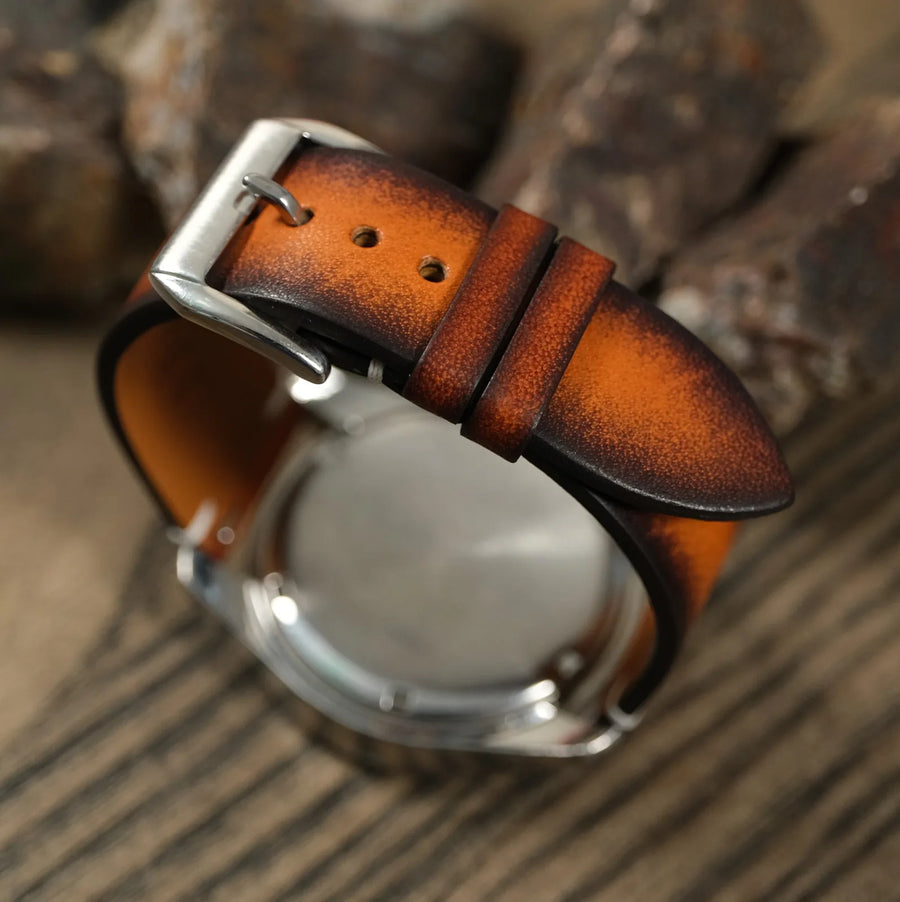
Can a Leather Watch Strap Get Wet? Rain, Sweat & Swims
Yes, a leather watch strap can get wet now and then: rain, a splash at the sink or a sweaty commute won't ruin it if you let it dry slowly afterward. What it can't handle is soaking. Showers, swimming and hot tubs pull the oils out of the leather, so keep a canvas strap for those days and save the leather for everything else.
Can a leather watch strap get wet at all?
It can, and in daily life it will. Leather is a skin, so it takes in moisture and gives it back. Trouble starts when water soaks right through. The fibers swell, dirt gets carried inward, and as the water evaporates it takes some of the natural oils with it. Do that often enough and the strap turns stiff, darkens unevenly and starts to crack at the flex points near the buckle.
So it comes down to how much water and how often. A few drops that you wipe off in a minute never reach the core. A strap that sits wet against your wrist for an hour, or goes under the shower every morning, never fully recovers. Most of the guides we read stop there. Below we go further: which everyday situations are fine, how different leathers react, and exactly what to do in the first day after a strap gets soaked.
Which everyday situations are fine, and which are not?
Use this list as a quick reference. The rule underneath it is simple: brief contact that you dry off is fine, but repeated or prolonged soaking is not.
- Light rain on the walk to work: low risk. Blot with a cloth once you are indoors, then wear the strap as usual.
- Washing your hands: low risk if brief. Push the watch up your wrist and keep soap and sanitizer off the strap; no need to take it off each time.
- Gym session or a hot, humid day: medium risk from sweat and salt. Loosen one hole, let the strap air out afterward, and rotate two straps if you train often.
- Winter slush and road salt: medium risk. Wipe white tide marks with a barely damp cloth, then dry; dark leathers hide salt marks best.
- Shower, bath or hot tub: high risk from hot water plus soap. Take the watch off, since this is the habit that ages straps fastest.
- Pool, ocean or water sports: high risk from chlorine and salt water. Switch to a canvas strap; leather and swimming do not mix.
Why is the strap, not the watch, the weak point?
Plenty of watches that wear leather straps are rated to 100 m or more. That rating covers the case, crown and crystal. It says nothing about the strap. A diver on leather can go swimming. The leather on it shouldn't. Think of the strap as the part with the lower tolerance, and set your water plans by it rather than by the dial.
It works the other way, too. A dress watch with modest water resistance often gets paired with leather precisely because neither is meant for swimming. If your watch and your strap both say "keep it dry," the choice is easy. The tricky case is the sports watch on a leather strap, and the easy fix there is a second strap for the beach. Swapping takes about a minute with the spring-bar tool that comes in every XILUGS box, and quick-release spring bars make it faster still.
Does the leather type change how a strap handles water?
Yes. The finish on the surface matters more than whether the leather is thick or thin. A pressed, finished grain sheds a splash better than an open, lightly finished one, and hand-dyed leathers show water marks more readily than evenly dyed ones.

- Epsom calfskin: firm, with a pressed grain. It's the most forgiving choice if you can't always plan around the weather.
- Togo and Babele: softer grained calfskins that take an occasional splash well if you dry them promptly. Our Togo vs Epsom vs Babele comparison covers how they feel on the wrist.
- Waxed cowhide: drops can leave darker spots that often blend back in as the wax settles, which is part of its appeal.
- Hand-dyed vegtan patina: the most likely to keep a water mark, because the color sits in the fibers rather than under a sealed finish.

Exotics deserve extra care. Alligator, ostrich and lizard cope with a brief spell of rain, but repeated wetting dries the surface and can lift the edges of the scales, and a lifted scale never fully settles back. If you want an exotic for daily wear, choose a darker finish and treat it as a dry-weather strap.
What should you do if your leather watch strap gets soaked?
Act within the first hour or so, and be patient for the next day. Speed matters at the start, and slow drying matters after that.
- Take it off and open it up. Unbuckle the strap and lay it flat so air reaches the lining side, not just the top.
- Blot, don't rub. Press a clean, dry towel along both sides. Rubbing wet leather can lift the surface finish.
- Dry it at room temperature. No hair dryer, radiator, car dashboard or direct sun. Fast heat shrinks the fibers and leaves the strap stiff.
- Give it a full day. Leather can feel dry on the surface long before the core is. Wear a different strap until tomorrow.
- Condition only if it needs it. If the strap feels tight or papery once dry, work in a very small amount of leather conditioner with a cloth. If it feels normal, leave it alone.
- Check the salt. White tide lines from sweat, sea water or road salt come off with a barely damp cloth, followed by another slow dry.
For the routine care that keeps a strap healthy between wet days, including cleaning, storage and how often to condition, see our full guide on caring for a leather watch strap so it lasts years.
How is a XILUGS strap built to cope with damp days?
No leather strap is waterproof, ours included. But construction decides how well a strap recovers. Each XILUGS strap is made by one artisan in our workshop in Ha Noi, following 18 steps, and three of them matter here.
First, a reinforcement layer sits inside the strap, so it holds its shape instead of going limp after a wet day. Second, the lining against your skin is Zermatt by default, which is soft and water-resistant. That slows sweat on its way to the outer leather, although it doesn't stop it. Third, every strap is saddle-stitched by hand at step 10, with two needles and one waxed thread. Each stitch is locked on its own, so if one is ever cut, the seam doesn't unravel.
You can see every stage, from cutting to final inspection, on our crafting process page.
Which straps handle wet weather best?
The practical answer is two straps: one leather that suits your climate, plus one for water. Every strap ships in a wooden box with a spring-bar tool, so switching is quick.
- Flat Taupe Canvas strap with leather trim: the strap for pools, beaches and gym days, from $69.
- Flat Sky Blue Epsom calfskin strap: our most practical calfskin for changeable weather, from $75.
- Flat Taupe Togo leather band: soft and grained, for everyday wear and occasional rain, from $69.
- Flat Vintage Brown Waxed Cowhide strap: built to show wear, so the odd water spot only adds character, from $69.

Browse the full canvas and sailcloth watch straps, compare grains across the Epsom calfskin watch strap collection, or see the exotic leather watch bands for dry-weather wear. Want a particular stitch color or lining? Use the design-your-own strap builder with live preview (from $69), or order a custom leather watch strap made to your size (from $69).
FAQ
Can I shower with a leather watch strap?
Better not. Hot water and soap together strip the leather's oils faster than anything else it meets, and the strap stays wet against your skin long after you've dried off. Take the watch off, or switch to canvas.
Is a leather strap ruined if it gets soaked once?
Usually not. Blot it, dry it flat at room temperature for a full day, and condition it lightly only if it feels stiff. One soaking dried slowly rarely does lasting damage. It's repeated soakings that wear a strap out.
Does sweat damage a leather watch band?
Over time, yes, because salt stays in the leather after the moisture has gone. Loosen the strap a notch on hot days, let it air out after wear, and rotate between two straps if you sweat a lot.
Is there a waterproof leather watch strap?
Not really. Linings and finishes can make leather more water-resistant, but no leather strap is waterproof. For swimming, a canvas or sailcloth strap is the honest answer.
Can I use a hair dryer to speed up drying?
No. Fast heat shrinks the fibers and leaves the strap stiff and prone to cracking. Room temperature and patience give a far better result.
Is water damage covered by returns?
Unused, non-personalized items can be returned within 30 days of delivery, and genuine defects are covered whenever they appear. Wear from water exposure isn't a defect, which is one more good reason to keep a canvas strap in your rotation.
Water doesn't have to be the enemy of a good leather strap. Dry it slowly, keep it out of the shower, and give the beach days to canvas. If you're adding a second strap to your rotation, check your lug width first with the XILUGS size guide, so both straps fit your watch the first time.