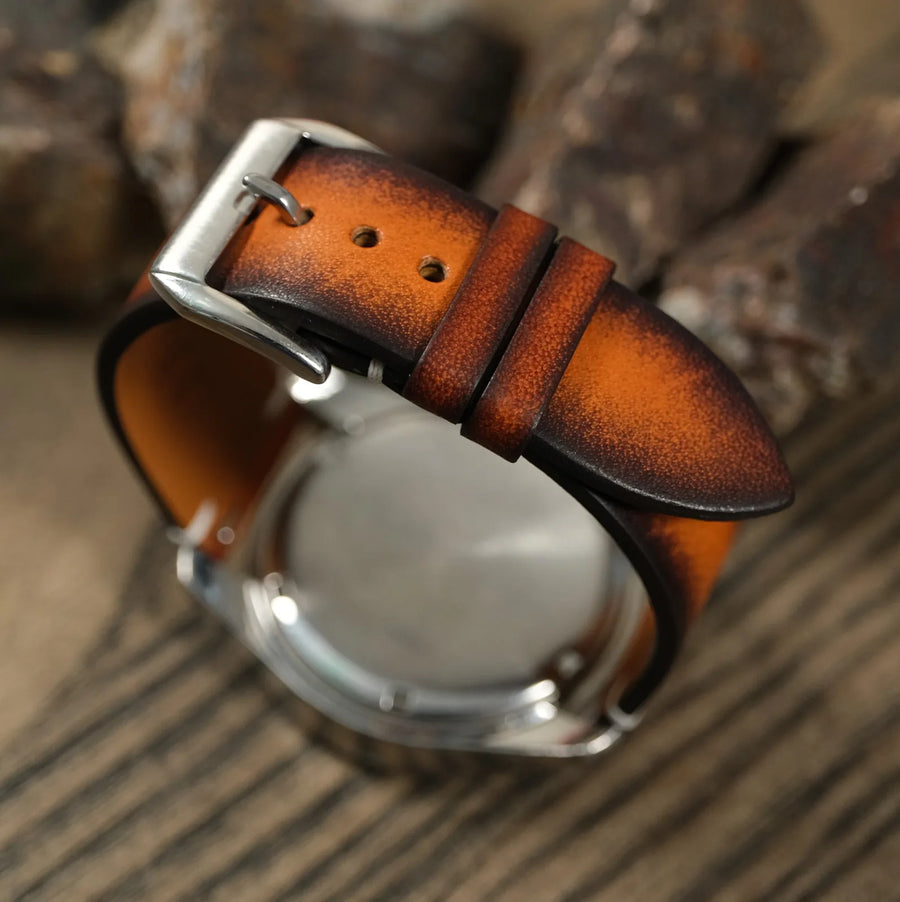
Ostrich Leather Straps: Full Quill, Smooth and Leg Compared
Ostrich leather comes in three cuts from one bird: full quill from the crown of the back, covered in raised follicle bumps; smooth from the rest of the body, with no pattern; and leg, with hard, reptile-like scales. Leg is the toughest for daily wear, full quill the most recognizable. XILUGS ostrich straps start at $109.
What makes full quill the rarest ostrich leather?
The pattern everyone recognizes as ostrich comes from one patch of the animal: the crown, across the back, where the quills were rooted. Every follicle leaves a raised round bump, and the spacing differs on every hide because it is grown rather than printed.

Only a small area of each bird carries those bumps, which is why full quill is the part cutters compete over. A watch strap is narrow but long, so the follicles have to run evenly along its whole length. Drift off the crown and the bumps fade out near the buckle, the fastest way to spot a strap cut from a poor part of the hide.
The leather itself is soft and rich in natural oils, so it stays supple and takes color deeply rather than holding it on the surface. Hold two full quill straps side by side and the rhythm of the bumps will never match.
How is smooth ostrich different from full quill?
Away from the crown, the same skin has no bumps at all: a fine, faintly pebbled surface with a soft matte sheen. It behaves like full quill in the hand because it is the same leather, supple, strong for its weight and deep in color.

Smooth ostrich is the choice for anyone who wants how ostrich feels without the pattern announcing itself. Under a shirt cuff most people will not know what it is, which is either the whole appeal or beside the point, depending on why you wanted ostrich.
A plain surface also makes smooth ostrich a natural fit for a rally cut: the perforations stand out cleanly when no follicles compete with them, which is why our turquoise smooth strap is made that way.
Why does ostrich leg look like a reptile?
The legs look like they came from a different animal. Instead of round follicles they carry hard scales, and they are the toughest of the three cuts: the fiber runs tighter, so leg holds a crisp painted edge and resists scuffing better than the body.

No two legs carry the same scale run, and there are two broad kinds to look for in a listing:
- Even scale stays fine and regular down the whole strap, and reads more formal.
- Graduated scale widens from ankle to knee, so one end of the strap is visibly finer; that end usually sits at the buckle.
- Either kind can be cut flat or padded, and both hold a sharper hand-painted edge than body ostrich.
Stitching changes the look as much as the cut. Tone-on-tone thread keeps attention on the follicles of full quill, while a contrast stitch such as cream on brown frames the scale line of a leg strap and makes the edge read sharper from across a room.
Full quill, smooth and leg side by side
| Cut | Pattern | Best for |
|---|---|---|
| Full quill | Raised follicles | Being noticed |
| Smooth | Fine, plain grain | Quiet luxury |
| Leg | Hard scales | Daily wear |
All three start at the same $109, so you are not paying extra for the rarer pattern. What differs is availability: quill and smooth straps sit in our ostrich body strap collection, while scaled straps have their own ostrich leg collection.
Which ostrich leather should you choose?
If you want people to notice the strap, choose full quill. If you want the material to be your business and nobody else's, choose smooth. If the watch is worn every day and you want the edge to look sharp in two years, choose leg.
Case metal helps decide too. The follicle texture of full quill carries well against yellow gold and two-tone, where the bumps catch light the way the case does. Smooth ostrich is the safer match for a steel dress watch. Leg suits a sports case where alligator would look overdressed; see real alligator vs embossed if you are weighing the two.
- Flat Brown Full Quill Ostrich: from $109, the classic follicle pattern on a warm neutral.
- Flat Emerald Green Full Quill Ostrich: from $109, deep color where the oils take dye well.
- Padded Turquoise Smooth Ostrich Rally: from $109, ostrich feel in a perforated rally cut.
- Flat Chestnut Brown Ostrich Leg: from $109, hard scales for an everyday watch.
Every ostrich strap is cut to your lug width between 12 and 24 mm, flat or padded, with a straight end or a curved end for $15 more. Want a color or spec not listed? Build it in the live preview strap builder.
How is an ostrich strap made at XILUGS?
Ostrich asks more of our 18-step process than calf does. The strap is hand-cut from a full hide against a steel rule, and on full quill that cut has to be placed so the follicles run evenly for the whole length. Skiving needs more care, because the follicle bumps sit at different heights.

From there it follows every other XILUGS strap: a reinforcement layer and a soft, water-resistant Zermatt lining, a hand saddle stitch that takes about an hour, then sanded, creased and hand-painted edges. Around twenty artisans work in our Ha Noi workshop, and a strap takes 3–5 business days from order to dispatch. Browse ostrich beside other skins in the exotic leather watch straps, which start at $105.
FAQ
Ostrich leg vs full quill: which should I buy?
Choose ostrich leg if the watch is worn every day: its hard scales and tight fiber resist scuffing and hold a crisp painted edge. Choose full quill for the classic raised-follicle look, which is softer and oil-rich but can mark if the bumps catch on rough surfaces.
Is full quill ostrich more durable than smooth?
No. They are the same leather from the same hide, so they wear the same way. Ostrich leg is the durable one of the three, because its fiber runs tighter.
Do the follicle bumps flatten over time?
They soften slightly as the strap breaks in, but they do not disappear, because they are part of the skin rather than embossed. Avoid catching them on rough surfaces, the one kind of mark that does not settle in.
Can I get ostrich in a specific lug width and length?
Yes, any width from 12 to 24 mm in pairs, and lengths from the 105/65 mm size for small wrists up to 135/105 mm. Odd widths such as 19 and 21 mm cost no more.
How should I look after an ostrich strap?
Keep it dry, let it breathe between wears and wipe rather than soak, with a little extra care around raised follicles and scales. Our guide to caring for a leather watch strap covers the routine.
Is ostrich a good alternative to other exotic straps?
Yes, especially leg, which reads as exotic but wears like an everyday strap. For a bolder texture, compare it with the exotics in our beaver tail vs shark strap guide.
Once you know which cut you want, the only thing left is fit: check your lug width and length against the XILUGS size guide before you order.