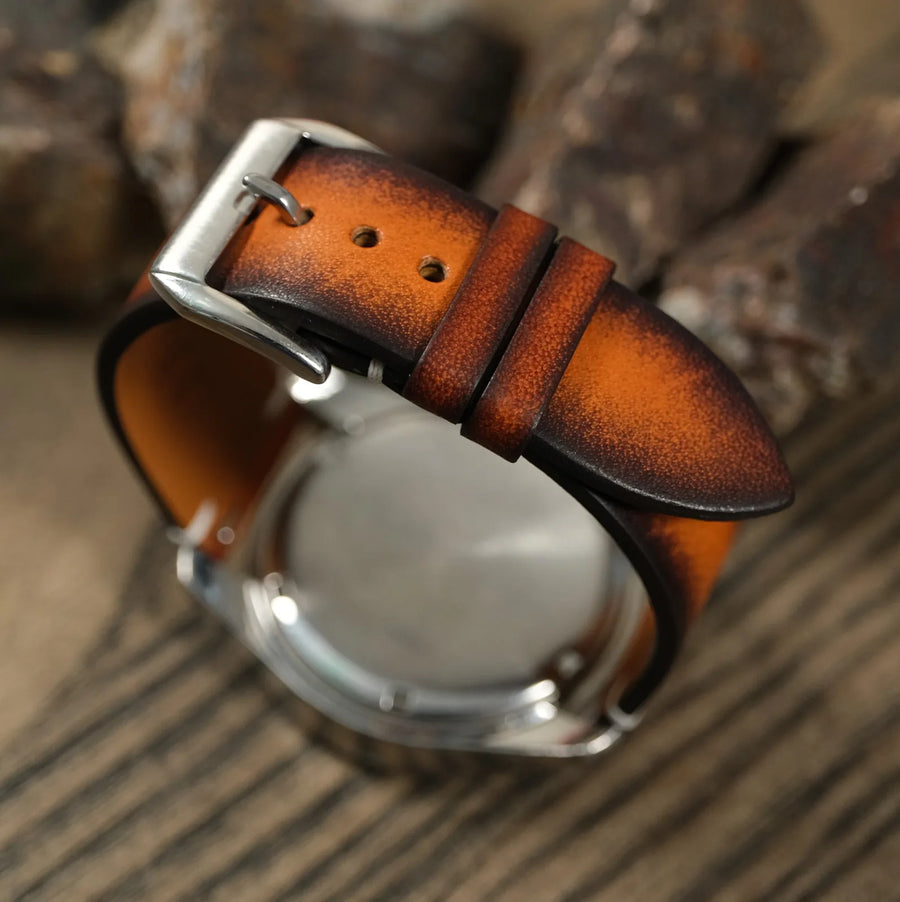
Handmade Leather Watch Strap: 18 Steps in Our Ha Noi Workshop
A handmade leather watch strap at XILUGS goes through 18 steps, all done by one artisan in our Ha Noi workshop: hand-cutting, skiving, lining, saddle stitching, edge work and a final check. Nothing is cut until you order, and each strap is made in three to five business days.
The 18 steps at a glance
The steps fall into six stages. Each one solves a specific problem, from comfort at the lug to how cleanly the edge wears after a year. Every step has its own photo on our crafting process page.
| Stage | Steps | Result |
|---|---|---|
| Cut and prepare | 1 to 4 | Folds without ridges |
| Build | 5 to 7 | Layers stay bonded |
| Sand the edge | 8 | Layers read as one |
| Stitch | 9 to 10 | A seam that holds |
| Finish | 11 to 16 | Edge and hardware |
| Check and ship | 17 to 18 | Matches your order |
The rest of this guide covers the steps you can feel and see once the strap is on your wrist, and what each one changes for you as the wearer.
Why we cut by hand, after you order
In step 1 the artisan cuts each strap from the hide by hand against a steel rule. A hide is read before it is cut: the firm leather along the back becomes straps, the soft belly does not, and the grain runs down the length of the strap so it does not stretch out of shape.

Because nothing is cut in advance, you choose the lug width, taper, thickness and length before any leather is used. We do not hold finished stock in your size. Every strap starts as your order, which is why the whole job takes three to five days instead of shipping from a shelf.
Inside the strap: steps 2 to 7
These steps build the parts you never see but always feel. They decide how the strap sits, how it folds and how well it keeps its shape after months of wear.
- Skiving (step 2): the leather is pared thinner where it folds at the lug and buckle.
- Reinforcement (step 3): an inner layer goes where the strap takes the most pull.
- Hammering (step 4): the layers are flattened so they sit true before bonding.
- Assembly (step 5): the top leather is aligned by hand with the lining, edge to edge.
- Rolling and shaping (steps 6 and 7): the layers are pressed together, then cut to the final taper and tip.
Skip the skiving and the fold leaves a hard ridge you can feel after an hour. Skip the reinforcement and the lug end slowly stretches. Neither shortcut shows in a product photo, which is exactly why both are on our list.

Assembly also decides whether a strap stays flat. Bond two layers that are not sitting true and the strap curls the moment it comes off the bench, so the hammering in step 4 is never skipped, even on a slim flat strap.
Why Zermatt lining is our standard
Every strap has two faces: the top leather you pick for looks, and the lining that touches your wrist all day. We use Zermatt as standard because it is soft and water-resistant, the layer that decides whether a strap is still comfortable in July.
- Where it sits: bonded by hand to the top leather in step 5, over the reinforcement layer, then saddle-stitched through both layers.
- Your options: Epsom, Togo or Swift lining costs $5 more than Zermatt in our live preview builder.
- Engraving: your initials or a date, up to 12 characters, can be engraved on the lining for free.
Water-resistant is not the same as waterproof. Our guide to whether a leather watch strap can get wet covers rain, sweat and swims.
What makes hand saddle stitching last
In step 9 the stitch holes are struck with a pricking iron held at one constant angle, which gives a hand seam its even slant. In step 10 the artisan works a single waxed thread from both sides with two needles, crossing inside every hole. It takes about an hour per strap.

That matters on a strap you wear every day. Because the thread crosses inside each hole, a stitch that gets cut does not let the seam run. Thread color and style are separate choices; see our guide to watch strap stitching types for classic, box and double stitching.
Edges, keepers and hardware
The edge gets three steps of its own. In step 8, before stitching, it is sanded through finer grits until the layers read as one. In step 11 a heated creaser draws a fine line inside it. In step 12 it is sealed and painted by hand in several thin coats, dried between each one.

Thin coats bend with the leather, so the edge stays smooth instead of cracking. Our watch strap edge color guide shows how a matched or contrast edge changes the look.
- Keepers (step 13): a fixed and a floating loop, cut and sized to this strap.
- Buckle holes (step 14): punched to the length you ordered, not to a standard pattern.
- Buckle and spring bars (steps 15 and 16): fitted in the finish you chose, quick release if you asked for it.
In step 17 the strap is checked against your order, then against itself: stitch spacing, a clean edge on both sides, holes on center. Straps that fail go back to the bench.
How to spot a well-made strap
Whoever made your strap, these are the quickest checks once it arrives:
- Stitch line: stitches evenly spaced and slanted at the same angle.
- Edges: smooth to the touch, with no visible layers, gaps or flaking paint.
- Folds: the strap bends easily at the lug end without a hard ridge.
- Holes: clean, round and centered on the strap.
- Width: the strap fills the lugs snugly, with no gap at the sides.
If something looks wrong, tell us, because defects are covered. Comparing workshops before you buy? Our honest guide to handmade strap makers lists what each brand publishes about itself.
Straps that show this work well:
- Padded Orange Epsom Calfskin Strap: from $75, the leather shown in our step photos.
- Padded Cognac Hand-Dyed Patina Strap: from $69, hand-dyed for depth of color.
- Flat Navy Babele Calfskin Strap: from $69, a slim everyday strap.
Prefer to choose every detail? Start a bespoke strap order, or browse all regular leather straps for ready designs.
FAQ
How long does it take to make a handmade strap?
Each XILUGS strap is made to order in three to five business days. US shipping is a flat $5.99 and takes 10 to 12 days, and it is free on orders over $350.
Is every strap really made by one person?
Yes. One artisan takes each strap from the first cut to the final check, so the work stays consistent from end to end.
Is the stitching done by machine?
No. Every strap is saddle-stitched by hand in step 10, which takes about an hour per strap.
Is a Zermatt lining waterproof?
No. Zermatt is water-resistant, which is not the same as waterproof, and the top leather and thread above it are still leather and thread. Avoid long soaks and let a damp strap dry naturally.
Where is the XILUGS workshop?
Our workshop is at 90 Nguyen Tuan Street, Thanh Xuan, Ha Noi. Its roots go back to 2016, and around 20 artisans work there today.
Can I return a handmade strap?
Unused, non-personalized straps can come back within 30 days from delivery. Engraved and custom-spec straps are final sale unless faulty; the refund policy has the details.
Ready to order? Check the lug gap and wrist size in our strap size guide before you choose a length.