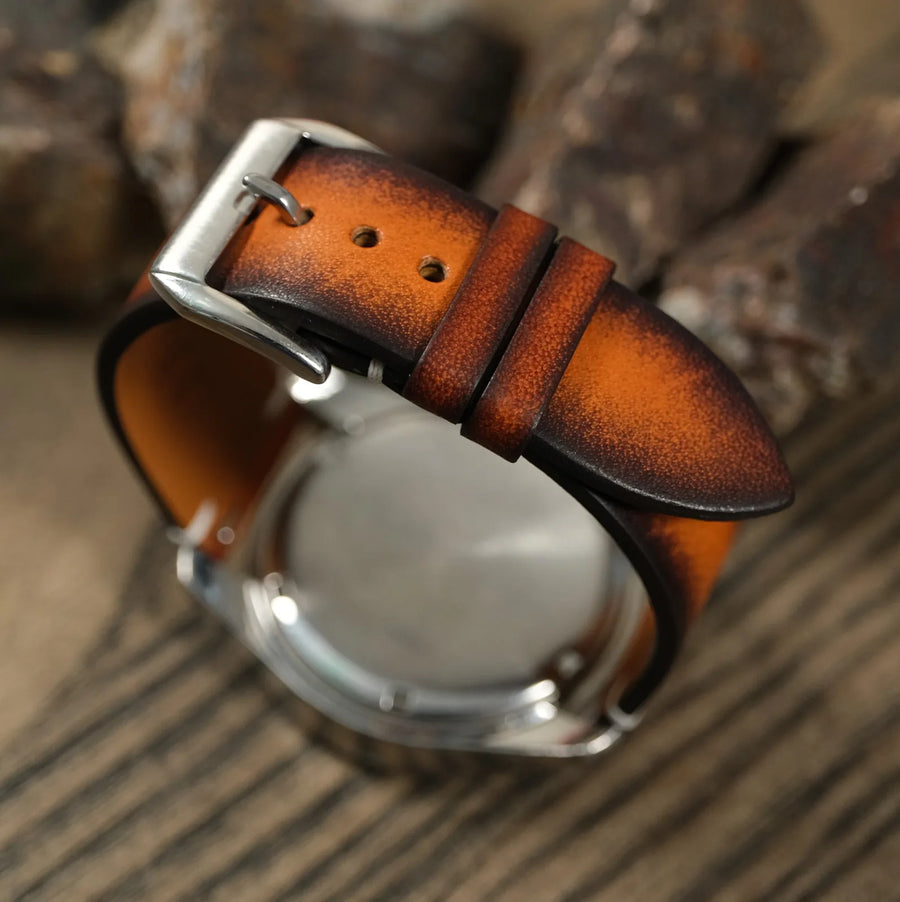
Watch Strap Edge Color: What It Is and How to Choose It
The edge of a leather watch strap is the thin side face where the top leather and the lining meet. Watch strap edge color is the color of the paint that seals it. At XILUGS each edge is sanded, burnished and hand-painted in thin coats, and you choose its color separately from the leather and thread.
What is the edge of a watch strap?
Turn a strap on its side and you see a narrow band a few millimeters tall. That band is the edge. Left raw, it would show two layers of fibrous leather that soak up sweat and fray at the corners. Painting it closes those fibers and turns the two layers into one clean outline.

The edge is easy to confuse with the stitching, but they are separate parts. The thread runs along the top surface, just inside the border. The edge is the side face below it. A strap can carry bright thread and a quiet edge, a quiet thread and a bright edge, or one accent color on both.
Edge vs stitching: two separate choices
Because thread and paint are different materials, the builder lists them as two options. The live builder today offers 23 thread colors and 24 edge paints, and the two palettes only partly overlap: Aqua Blue and Mint Green exist as thread, while Golden, Tan and Navy exist as edge paint.
- Match leather keeps the edge in the strap's own color.
- Match underlay paints it in the color shown under the holes of a rally strap.
- Custom lets you pick any one paint from the palette.
Keepers, the two loops that hold the strap tail, are a third separate choice. They are cut from leather rather than painted, so we cover them in our watch strap keeper guide. Thread styles, from classic to box stitch, have their own guide to stitching types.
Why edge color changes the whole look
The edge is only a few millimeters tall, yet it runs the full length of both strap halves, on both sides. It is the outline of the piece, and an outline is what the eye reads first. Change only the edge and the same leather can look calmer or sharper.

There are three ways to use it:
- Same color as the leather. The edge disappears and the strap reads as one piece. It is the safe choice for dress watches.
- A darker tone. Black on navy or dark brown on tan adds a crisp line without looking loud.
- A contrast color. Red on brown or yellow on black turns the edge into a design detail, usually tied to the thread or the racing holes.
On a padded strap the side face is taller than on a flat one, so a contrast edge shows more on padded forms. Our padded vs flat strap guide explains how the two forms sit on the wrist.
Which edge color suits which leather?
No pairing is the only right one, but these combinations tend to look intentional. Treat the table as a starting point and confirm it in the live preview.
| Leather | Quiet edge | Accent edge |
|---|---|---|
| Black | Black | Red or yellow |
| Brown or tan | Dark brown | Cream or red |
| Navy | Navy | Orange or white |
| Patina | Darkest tone | Rarely needed |
| Exotics | Match the hide | Repeat the thread |
With exotics such as alligator, ostrich and lizard, a matched edge keeps the eye on the scales or quills. Hand-dyed patina leather already shifts in tone, so the darkest shade in the hide usually makes the best frame.

That lizard strap shows a useful rule: when you skip the thread, the edge becomes the only outline, so a contrast color there reads stronger than usual. If you want a quieter stitch-free strap, match the edge to the hide.
How XILUGS finishes an edge by hand
Three of the eighteen steps on our crafting process page belong to the edge. Each strap stays with one artisan from first cut to final check.
- Sanding (step 8). Before stitching, the raw edge is sanded through finer and finer grits until the top leather and lining read as one surface.
- Creasing (step 11). After saddle stitching, a heated creaser draws a fine line just inside the edge, which compresses the fibers.
- Painting (step 12). The burnished edge is sealed and painted by hand in several thin coats, dried between each one.
A single thick coat would be faster, but it would peel at the first bend. Waiting for those coats to dry is one reason a strap takes three to five days in our Ha Noi workshop, along with about an hour of hand stitching per strap. Our 18-step workshop walkthrough shows the full sequence.
Will a painted edge wear over time?
A sealed edge still rubs against cuffs, desks and keyboards every day. After long wear a corner can scuff or lose some gloss. That is normal, and it is why the paint goes on in thin layers: thin coats flex with the leather rather than flaking off it.

To keep an edge looking new, keep the strap dry and wipe it with a soft cloth, as our leather strap care guide explains. Store spare straps flat. If an edge ever needs attention, email support@xilugs.com with a photo and we will advise.
Picking the edge in the builder
Both custom tools include the edge option. In the bespoke strap builder you set leather, thread, edge, keepers and underlay along with lug width, length, thickness and form. In the live preview builder the strap redraws on screen as you click. Custom straps start from $69.

A simple rule if you are unsure: match the edge to the thread for a coordinated look, or to the leather for a quiet one. A contrast edge works best when the same color appears somewhere else, on the holes, the keepers or the watch dial. These straps fit the ideas above:
- Navy Togo Calfskin Leather Watch Strap: from $69, a matched navy edge for a quiet, everyday look.
- Flat Navy Epsom Rally Strap, Orange Holes: from $75, an orange edge that repeats the racing holes.
- Navy Rally Turquoise Holes Lizard Strap: from $109, a stitch-free strap where the edge is the accent.
Want to see more contrast-edge designs first? Browse our rally watch straps, then build your own version in the preview builder.
FAQ
How many edge colors can I choose from?
The live builder lists 24 edge paints, plus the options to match the leather or the underlay. The thread palette is a slightly different set, so not every thread color has an identical paint.
Should the edge match the stitching or the leather?
Match it to the leather for the quietest, most formal result. Match it to the thread when you want one accent color to frame the strap. Avoid a third unrelated color unless it also appears on the watch.
Does a custom edge color cost extra?
No. In the current price rules the edge color has no surcharge; the price depends on the leather and options such as the buckle or a curved end. Regular leathers start from $69 and exotics from $105.
Can I return a strap if I dislike the edge color?
Straps made to your chosen colors count as custom, so they are not returnable for a change of mind, only if faulty. Check the live preview carefully, and email us a photo of your watch if you are unsure.
Before you order, check lug width and length in our size guide so the edge you choose frames a strap that fits.